10 flexible assets
Three settings per asset produce 59,049 possible combinations in a single 15-minute interval.
A FUNDAMENTALLY DIFFERENT WAY OF COMPUTING. DEVELOPED BY QUANTADUTCH.
What if complex problems did not require more computing power, but a fundamentally different way of computing?
Energy networks, factories and logistics systems are becoming more complex. Every additional variable, constraint or decision increases the number of possible solutions.
A common response is to add computing power: faster processors, more memory and larger infrastructure. QuantaDutch asks a different question: what if we change the way we approach the problem, rather than simply calculate faster?
That thinking led QuantaDutch to develop its own optimisation software for problems with exceptionally large numbers of possible combinations. The technology is designed to run on conventional computer hardware, without treating large-scale computing infrastructure as a prerequisite. Not more computing power by default, but a fundamentally different approach.
The technology
It starts with how we approach complexity. As systems become more complex, the number of possible combinations often grows exponentially. Established optimisation methods rely on mathematical models, algorithms, heuristics and powerful computers. More computing power does not remove the fundamental growth of combinatorial solution spaces.
QuantaDutch takes a different route. Our proprietary technology starts from a different premise: how a problem is described and structured also shapes the calculations required. Relationships between variables, constraints and possible configurations are central.
Not merely faster calculations, but a different way of dealing with the structure of the problem. QuantaDutch develops this approach to handle complex optimisation more efficiently, using conventional computer hardware as a practical starting point.
Energy in practice
Imagine an energy hub with ten flexible assets, such as batteries, EV chargers and heat pumps. Each asset has just three possible settings every 15 minutes. That sounds manageable. Yet those settings already produce 59,049 possible combinations in a single 15-minute interval.
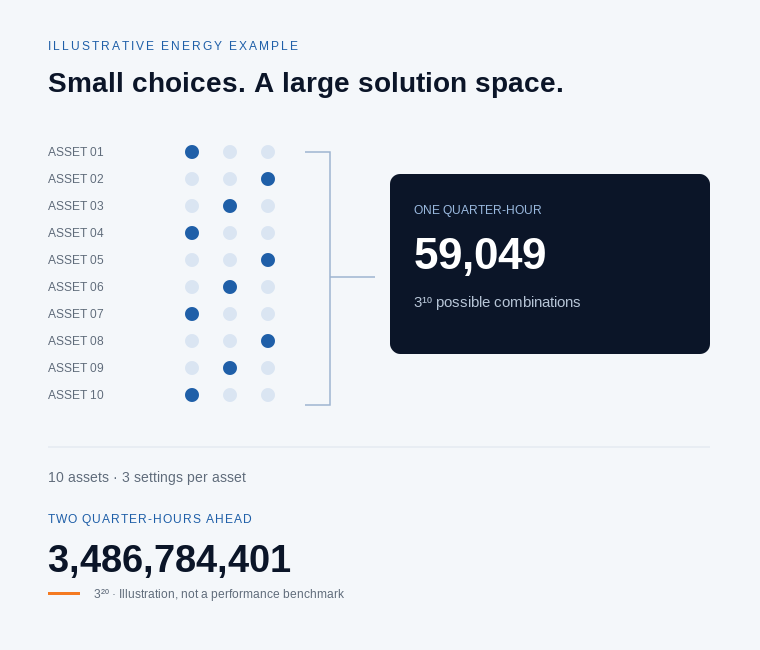
Three settings per asset produce 59,049 possible combinations in a single 15-minute interval.
Looking two 15-minute intervals ahead produces nearly 3.5 billion combinations in this simplified example.
Grid capacity, energy prices, storage, local generation, charging demand, contracts and technical limits add further constraints.
Illustrative calculation: 10 assets with 3 possible settings per 15-minute interval. These figures illustrate combinatorial growth; they are not performance benchmarks for QuantaDutch.
The benefits
Complex optimisation does not have to start with ever more computing power. QuantaDutch develops proprietary technology that approaches complex combinatorial problems differently, with conventional computer hardware as its starting point.
Heavy infrastructure is not the default starting point. QuantaDutch develops technology for complex optimisation on conventional computer hardware. Specialised computing clusters need not be the first step.
Less reliance on expensive computing infrastructure. By organising complex calculations differently, QuantaDutch aims to reduce reliance on additional hardware and cloud capacity. This can help limit infrastructure and operating costs.
More efficient calculations with fewer computing resources. Reducing computational load can also reduce energy consumption. Actual savings are measured for each application.
From a complex problem to practical validation. Explore the technology in an existing environment without first committing to a major infrastructure project.
Applications
Different applications. The same underlying computational challenge. In each of these sectors, decisions, constraints and dependencies can create an enormous number of possible configurations. Finding a workable solution becomes increasingly difficult.
Get more from existing energy capacity.
A business park has solar panels, battery storage and EV charging facilities. Its businesses have changing energy needs. At peak times, demand exceeds available grid capacity, while a grid connection upgrade is not immediately possible. When should batteries charge or discharge? Which charging points take priority? How should generation and consumption be coordinated? Every decision affects other parts of the system.
QuantaDutch develops technology for complex configuration problems involving many interdependent choices. In an energy hub, we explore how generation, storage, consumption and available grid capacity can be better coordinated.
Use existing grid capacity more efficiently, reduce peaks and increase flexibility within existing technical limits.
Organise more deliveries within the same capacity.
A distribution centre needs to make hundreds of deliveries each day with a limited fleet. Each delivery has a destination, a delivery window and specific requirements. Vehicle capacity, driving time, driver availability and traffic affect the plan. The number of route and scheduling combinations grows rapidly.
QuantaDutch explores a different approach to complex combinations of routes, constraints and dependencies in route planning and capacity allocation.
Use vehicles and resources more efficiently, reduce unnecessary mileage and align plans more closely with operational conditions.
Get more from existing production capacity.
A factory makes different products using machines shared across multiple production orders. Orders have distinct processing times, material requirements and deadlines. Maintenance, staffing and energy use must also be considered. A delay at one machine can affect other production lines. Meanwhile, the number of possible production sequences grows rapidly.
QuantaDutch explores the application of its technology to production scheduling, capacity allocation and coordination of machines, materials and people.
Make better use of existing production capacity, reduce waiting times and deploy resources more effectively.
More variables. More dependencies. Vastly more possible configurations. QuantaDutch develops technology that does not simply add computing power, but fundamentally changes the way this complexity is approached.
About us
QuantaDutch grew from a collaboration spanning more than twenty-five years. A shared interest in patterns, complex systems and the relationships between them grew into a company developing its own optimisation software.
John leads the technological core. His curiosity about patterns, mathematical relationships and complex systems forms an important foundation for the technology.
Edwin brings more than twenty years of experience in the financial sector. His background in entrepreneurship, governance, risk management and contractual structures supports business development.
Jan fulfils a supervisory and advisory role, supporting continuity and careful decision-making.
QuantaDutch values technological depth, careful validation and collaboration with organisations genuinely interested in investigating complex challenges.
Pilot
Major technological possibilities often begin with one concrete problem. We begin with a clearly defined problem and explore together what our software could offer in your specific situation.
A pilot provides a structured way to test the technology’s capabilities and practical value for a specific problem. We agree in advance which results matter and how they will be assessed.
Discuss a pilot
Follow QuantaDutch
From fundamental ideas to practical applications, we share insights and developments in more efficient computing, energy, manufacturing and logistics.
For business developments, technological insights and partnership opportunities.
View LinkedInFor visual explanations, technology concepts and in-depth exploration.
View YouTubeContact
Is your organisation reaching the limits of conventional approaches to complex planning, constrained capacity or optimisation problems with vast numbers of possible combinations? QuantaDutch welcomes discussions with organisations, technology partners and researchers. We start with the problem and explore together whether a next step makes sense.